
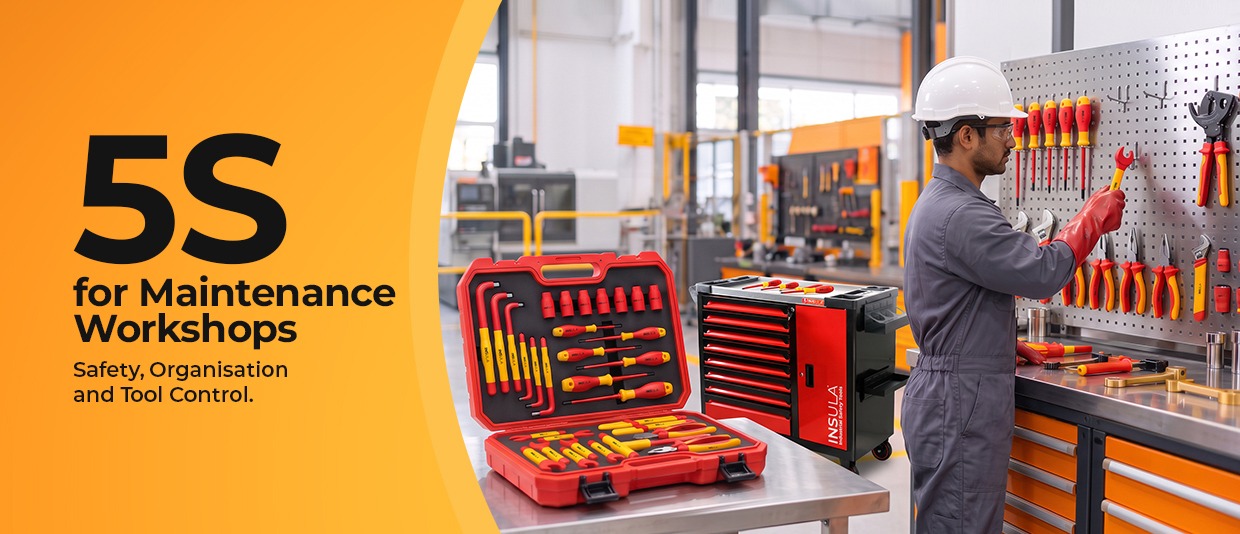
5S for Maintenance Workshops: Safety, Organisation and Tool Control
The 5S methodology, originally developed in Japanese manufacturing, gives workshops a structured way to bring order to tool storage and work areas. This article explains what 5S means for a maintenance workshop, why it matters for safety and tool control, and how to put it into practice.
What Is 5S in a Maintenance Workshop
5S stands for five Japanese words, each describing a stage in organising a workspace: Sort, Set in Order, Shine, Standardise and Sustain. In a maintenance workshop, this translates into removing unnecessary items from work areas, assigning a fixed place for every tool, keeping equipment clean and inspected, documenting the standard layout, and building habits that keep the system running over time.
Unlike a one-time cleanup drive, 5S is meant to be an ongoing discipline. A workshop that sorts its tools once and never repeats the process will drift back into clutter within weeks.
Why 5S Matters for Workshop Safety
Disorganised workshops create hazards that are easy to overlook until an incident occurs.
Reduced trip and fall hazards. Loose tools, cables and offcuts left on walkways are a leading cause of workshop injuries. Sorting and clearing floor space removes this risk at the source.
Faster identification of damaged tools. When tools have a fixed storage location and a visible outline or label, a missing or damaged item is noticed immediately rather than discovered mid-task.
Lower risk of using the wrong tool for the job. A cluttered toolbox increases the chance a technician reaches for a similar-looking but unsuitable tool. This matters even more where non-sparking or insulated tools are required for hazardous environments, since picking up an incorrect tool by mistake can undermine the entire safety setup.
Cleaner electrical and mechanical work areas. Shine, the cleaning stage of 5S, extends to machines and panels. Regular cleaning surfaces early signs of wear, leaks or corrosion before they become failures.
Why 5S Improves Tool Control
Tool control is the practice of knowing where every tool is at all times, who has it, and whether it has been returned in working condition. Poor tool control leads to lost tools, foreign object damage in machinery, and wasted time searching for equipment.
5S supports tool control in several concrete ways:
- Shadow boards and outlined storage make it obvious at a glance when a tool is missing.
- Fixed locations reduce the time technicians spend searching, which directly improves maintenance turnaround.
- Standardised kits for specific jobs (a set of insulated tools for electrical panel work, for example) ensure the right tools travel together and come back together.
- Regular audits, built into the Sustain stage, catch tools that have gone missing or been damaged so that they can be ordered before they cause a bigger problem.
For workshops handling critical maintenance, from electrical panels to hazardous area equipment, this level of control is not a convenience. It is part of the safety process itself.
Implementing 5S in a Maintenance Workshop: Step by Step
1. Sort (Seiri) Go through every tool, consumable and fixture in the workshop. Separate what is used regularly from what is rarely or never used. Remove obsolete, duplicate or broken items from the work area entirely. Damaged or broken tools should be reordered and replenished so that they are available when the need arises
2. Set in Order (Seiton) Assign a specific, labelled location for every remaining tool. Shadow boards, foam cutouts and colour-coded storage all make it visually obvious when something is out of place. Group tools by task or by trade so a technician can collect an entire kit in one motion.
3. Shine (Seiso) Clean tools, benches, machines and floors on a set schedule, not only when they look dirty. Cleaning doubles as inspection: it is often the moment a crack, leak or loose fitting is first spotted.
4. Standardise (Seiketsu) Document the agreed layout, labelling system and cleaning schedule so that any technician, including a new hire, can maintain it without guesswork. Photos of the correct workshop layout posted on the wall work well for this.
5. Sustain (Shitsuke) Build 5S checks into routine supervision. Short, regular audits, rather than infrequent large ones, are what keep a workshop from sliding back into clutter.
Choosing the Right Tools Supports 5S
5S is a system for organising tools, but it works best when the tools themselves are built for durability and clear identification. Tools that corrode, chip or lose their markings quickly undo the labelling and standardisation work that 5S depends on. Workshops handling hazardous or electrical maintenance also need tool sets that are purpose-built for the environment, whether that means non-sparking tools for flammable atmospheres or insulated tools for live electrical work, so that the right kit is always the one on the shadow board.
Bombay Tools Centre supports this directly with toolkits and tool trolleys built around foam cutouts shaped to each individual tool. Every tool has one exact place, so a missing tool is spotted at a glance instead of discovered mid-job. This keeps the workshop visibly clean and orderly, and puts the Set in Order and Sustain stages of 5S into practice without any extra system to maintain.
Conclusion
5S gives maintenance workshops a repeatable framework for safety and tool control, turning an ad hoc collection of tools into an organised, auditable system. The methodology works alongside good tool selection and storage practices, not in place of them. Workshops that combine disciplined 5S practice with reliable, well-maintained tools see fewer incidents, faster maintenance cycles and better accountability over their tool inventory.