
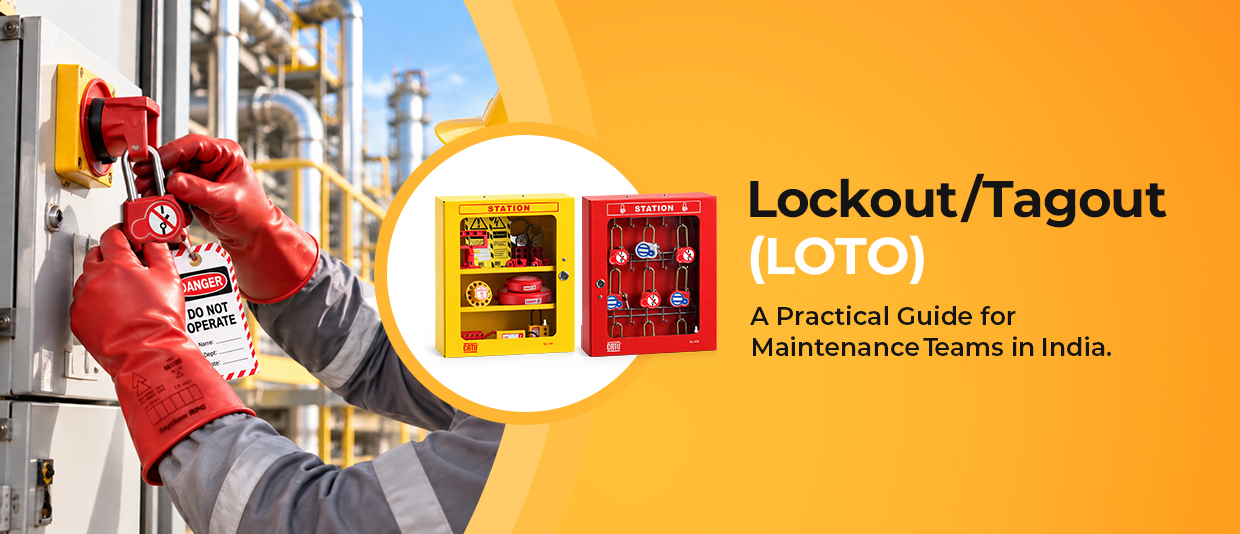
Lockout/Tagout (LOTO): A Practical Guide for Maintenance Teams in India
Unexpected start-up of machinery or the unplanned release of stored energy during servicing is one of the recognized causes of serious workplace injuries in maintenance settings. Lockout/Tagout (LOTO) exists to control that risk, and for maintenance teams it's one of the procedures where a missed step can have severe consequences.
This guide breaks LOTO down in plain, practical terms for Indian plants and workshops: what it is, why it matters under Indian law, how to apply and remove it correctly, and where maintenance teams most often run into trouble.
What Is Lockout/Tagout?
Lockout/Tagout is a safety procedure used to ensure that dangerous machines are properly shut off and cannot be started up again before maintenance or repair work is completed. It combines two actions:
- Lockout physically isolating an energy source (electrical, mechanical, hydraulic, pneumatic, thermal, or chemical) using a lock so it cannot be re-energized.
- Tagout attaching a warning tag to the isolation device to inform others that the equipment is not to be operated until the tag is removed by an authorized person.
Lockout vs. Tagout: What's the Real Difference?
People often use "lockout" and "tagout" interchangeably, but they serve different purposes:
- Lockout physically prevents the energy-isolating device from being operated for example, a padlock on a circuit breaker or valve. It provides a physical barrier.
- Tagout is a warning label attached to the isolating device. It communicates not to operate the equipment, but it does not physically stop anyone from doing so.
Good practice favors lockout over tagout-only wherever a lockout device can be used, precisely because a tag can be ignored, missed, or removed by someone unaware of the hazard, while a lock cannot.
The 8 Steps to Apply Lockout/Tagout
A properly executed LOTO procedure generally follows these steps:
- Prepare for shutdown. The authorized employee identifies the type and magnitude of energy the machine uses, the hazards involved, and the correct method of control before touching anything.
- Notify affected employees. Everyone who works near or depends on the equipment should know it's being shut down, and roughly how long it will be out of service.
- Shut down the equipment. Follow the manufacturer's or site's normal, orderly shutdown procedure don't just hit an emergency stop unless that is the prescribed method.
- Isolate the energy source(s). Disconnect, block, or otherwise isolate every energy source feeding the machine electrical, hydraulic, pneumatic, gravitational, thermal, or chemical.
- Apply lockout/tagout devices. Attach the appropriate lock and tag to each isolation point. Different energy types often require different devices a valve lockout differs from an electrical panel lockout or a plug lockout.
- Release or restrain stored energy. Springs, capacitors, elevated components, and pressurized lines can hold energy even after the main source is isolated. This stored ("residual") energy must be safely dissipated, blocked, or restrained.
- Verify isolation. Before work begins, confirm the equipment is at zero energy for example, by attempting to start it (through normal controls) after locking it out, or by testing with appropriate instruments. Also confirm no one is in a position to be harmed.
- Perform the servicing or maintenance. Only once isolation is verified should work actually begin.
When verifying isolation on live electrical panels or in hazardous atmospheres, VDE-insulated tools and non-sparking (spark-resistant) tools are commonly specified, since a standard steel tool can either conduct current or generate an ignition-capable spark during testing and isolation work.
Safely Restoring Equipment: The Release Steps
Removing LOTO is just as procedural as applying it. Before re-energizing:
- Inspect the work area to ensure tools, guards, and components are properly reinstalled and no one is exposed to hazards.
- Confirm all employees are safely positioned away from the equipment.
- Notify affected employees that the lockout/tagout devices are about to be removed and the machine will be re-energized.
- Remove the devices normally by the same authorized employee who applied them.
- Re-energize and test the equipment to confirm normal operation before returning it to service.
Common Types of Energy Sources to Control
A single machine can have more stored or live energy than it appears to. Maintenance teams should account for:
- Electrical - mains power, capacitors, batteries, backup generators
- Mechanical - flywheels, springs, gears in motion
- Hydraulic - pressurized fluid in lines and cylinders
- Pneumatic - compressed air or gas
- Thermal - hot surfaces, steam lines
- Gravitational - raised components that could fall (e.g., unsupported machine heads or elevator cars)
- Chemical - residual reactive materials in piping
Choosing the Right LOTO Devices and Supporting Tools
Different isolation points call for different hardware. Common device categories include:
- Padlocks (keyed-alike, keyed-different, or combination) as the core locking mechanism
- Hasps, which let multiple workers each apply their own lock to a single isolation point
- Valve lockouts, circuit breaker lockouts, plug lockouts, and blind flange lockouts for equipment-specific isolation
- Group lockout boxes, used when several people or crews are working on the same equipment simultaneously
- Tags, clearly indicating who applied the lock, when, and why
Alongside the isolation hardware itself, the hand tools used to carry out the isolation and verification work matter. For electrical panels, switchgear, and live-adjacent work, 1000V-class VDE insulated tools (screwdrivers, pliers, spanners, cable cutters) reduce shock risk during isolation and testing. For work in refineries, chemical plants, and other hazardous atmospheres, non-sparking tools made from aluminium bronze (AlBr) or beryllium copper (BeCu) such as spanners, hammers, and sockets reduce the risk of an ignition source while machinery is being locked out or serviced. Bombay Tools Centre (thebombaytools.com) manufactures both categories for the Indian and export markets, alongside stainless steel and precision crimping tools used in maintenance work.
LOTOTO: Adding "Tryout" to the Process
Some organizations have moved from LOTO to LOTOTO (Lockout, Tagout, Tryout), adding an explicit "tryout" step where the worker attempts to operate the equipment through its normal controls after applying the lock, to actively confirm zero energy rather than assuming it. Many safety professionals view this as a more rigorous verification practice than relying on isolation alone.
Conclusion
LOTO is one of the simplest safety concepts to explain and one of the easiest to get slightly, dangerously wrong in practice. For maintenance teams, the discipline isn't in understanding the theory it's in applying the same rigor to the machine you've serviced a hundred times as you would to one you've never touched. A written, machine-specific procedure; the right devices and tools for the job; genuine verification; and consistent training are what turn LOTO from a legal requirement into an actual safeguard.