
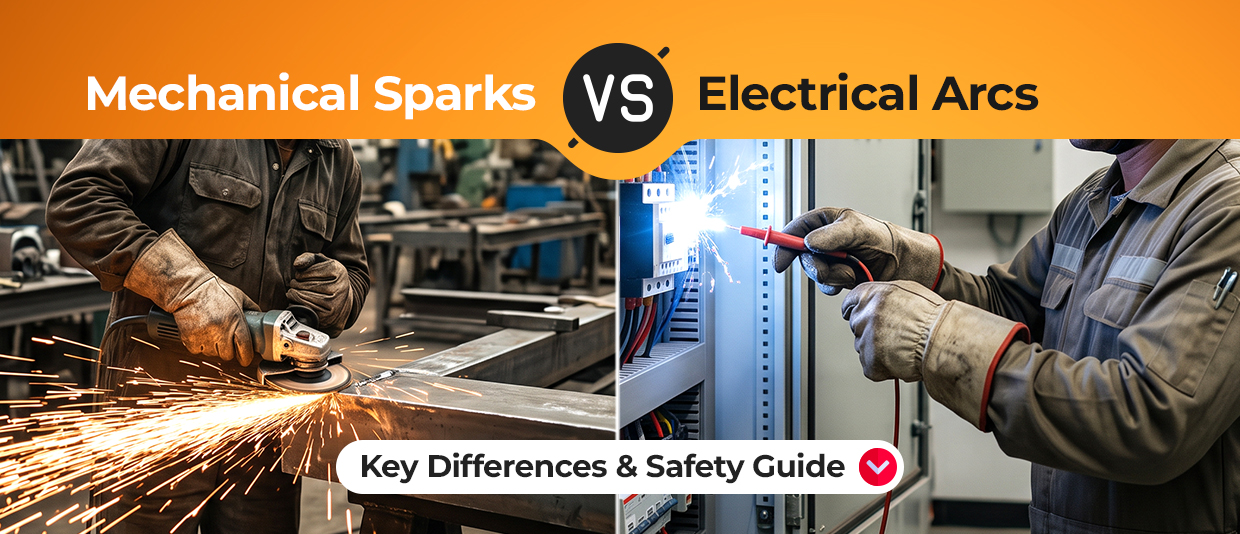
Mechanical Sparks vs. Electrical Arcs: Key Differences & Safety Guide
Mechanical Sparks vs. Electrical Arcs: Sparks show up constantly on the industrial floor - grinding, cutting, friction, electrical arc. But not all sparks are the same, and treating a mechanical spark like an electrical one can lead to improper planning to mitigate them.
This guide breaks down the difference between mechanical sparks and electrical arcs, the hazards each one creates, and how the right tool choice i.e. non-sparking tools or insulated tools help maintenance teams control both risks before they happen.
What Is a Mechanical Spark?
A mechanical spark is caused by friction or impact two hard surfaces colliding or shearing, throwing off hot metal particles. Common sources include:
- Grinders and cutting tools
- Chisels and hammers
- Metal-on-metal contact
- Dropped tools
Mechanical sparks are low-energy and momentary. Their main hazard is ignition specifically, igniting flammable vapors, dusts, or gases in a combustible atmosphere.
What Is an Electrical Arc?
An electrical arc is a sustained discharge of current through the air between two conductors. It's typically caused by:
- Insulation failure
- Loose or corroded connections
- Accidental contact with live equipment
Electrical arcs can reach extreme temperatures and escalate into an arc flash or arc blast a leading cause of severe burns and fatalities in electrical maintenance work.
Mechanical Sparks vs. Electrical Arcs: Key Differences
Factor | Mechanical Spark | Electrical Arc |
Source | Friction / impact | Electrical current jumping a gap |
Energy | Low | Can be extremely high |
Duration | Momentary | Can sustain until the circuit is broken |
Main hazard | Ignition of flammable material | Burns, blast, fire, equipment damage |
Required consideration | Intrinsically-safe equipment, Non-sparking tools | Arc-rated PPE, VDE Insulated tools |
How Tool Choice Reduces Both Hazards
Tool selection is one of the simplest and most effective ways to control spark and arc risk before work even begins.
Non-Sparking Tools
Non-sparking tools typically made from beryllium copper (BeCu) or aluminum bronze (AlBr), reduce the friction-generated sparks produced by metal-on-metal contact.
In classified hazardous locations such as tank farms, paint booths, and chemical plants, replacing standard steel hand tools with non-sparking versions significantly mitigate ignition risk during routine mechanical work like hammering, scraping, or loosening fasteners. Non-sparking tools don't eliminate mechanical spark risk entirely, but they cut it substantially where flammable atmospheres are a concern.
Insulated Tools
Insulated tools protect against a different hazard entirely: accidental contact with live conductors.
Properly rated insulated tools used according to their voltage rating, applicable standards, and safe work procedures provide an additional layer of protection against contact with energized parts. They do not eliminate arc flash risk or replace de-energization, PPE, or electrical safety procedures. Insulated tools are essential any time work happens near energized equipment, including during de-energization itself, since verifying a zero-energy state carries its own contact risk.
The Key Takeaway: Neither Tool Type Substitutes for the Other
- Non-sparking tools address ignition risk in combustible atmospheres.
- Insulated tools address shock and arc risk around live electrical systems.
- Using the wrong tool for the hazard an insulated tool in a hazardous atmosphere without spark-reduction properties, or a non-sparking tool near live conductors without an insulation rating can create a catastrophic gap in protection.
- When electrical work is carried out in hazardous zones you will require specialised tools i.e. non-sparking insulated tools that have an insulation layer as well as made from non-sparking alloy.
Neither tool type replaces PPE or procedure. Maintenance teams should select tools based on the specific hazard present and train staff on when each type applies, treating tool selection as part of the same risk assessment that determines PPE and work permits.