
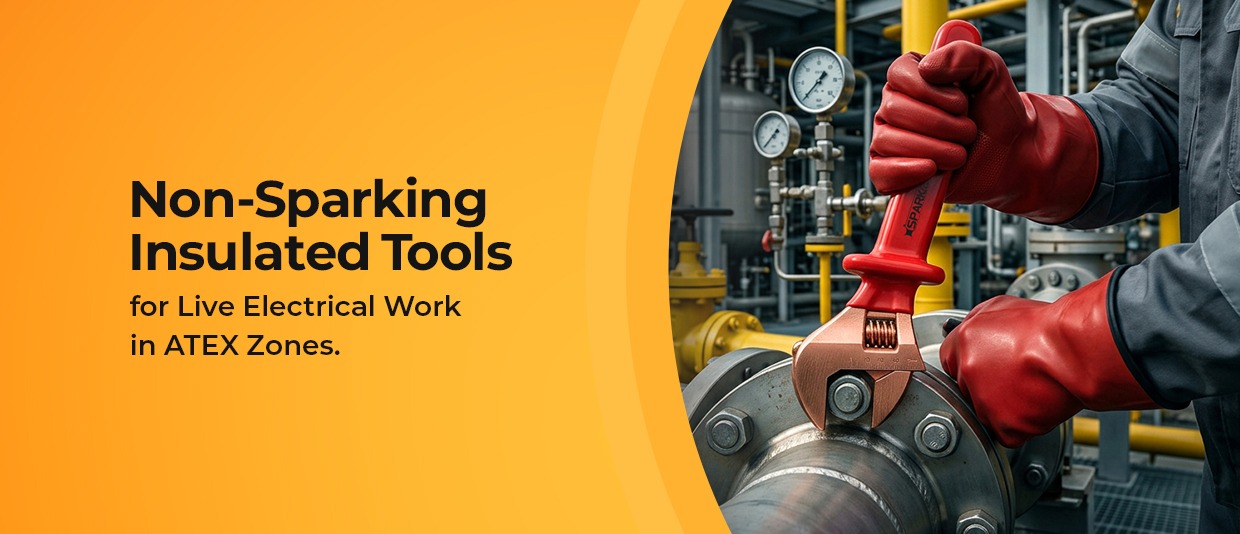
Non-Sparking Insulated Tools for Live Electrical Work in ATEX Zones
Non-sparking insulated tools are hand tools built from spark-resistant, non-ferrous alloys such as beryllium copper or aluminum bronze, coated with a dielectric insulation layer rated for live electrical work up to 1000V AC / 1500V DC.
Certain industrial environments carry two hazards at once: an explosive atmosphere from flammable gases, vapors, or dust, and exposed live electrical parts that cannot always be shut down. A standard tool addresses only one of these risks. Non-sparking insulated tools are built to address both, in the same tool, at the same time.
Most industrial safety programs treat electrical risk and explosion risk as separate problems, solved by separate tools. Insulated tools protect a technician from shock and arc flash while working on or near a live circuit. Non-sparking tools protect the surrounding atmosphere from ignition by preventing the friction and impact sparks that ordinary steel tools can throw off when they strike a hard surface.
The gap appears in facilities where both hazards exist in the same physical space at the same time. This is common in oil and gas operations. A refinery control room, a compressor skid, a tank farm junction box, or a boiler's instrumentation panel can sit inside a classified explosive atmosphere while also carrying live voltage that cannot be de-energized without stopping a continuous process. Shutting down a boiler or a distillation unit to make a routine electrical repair is often not commercially or operationally realistic. The work has to happen live, inside the hazardous zone, with a tool that will not shock the technician and will not ignite the atmosphere around them.
How These Tools Are Made
The base metal is a non-sparking alloy that prevents friction and sparks, and the working surface carries a dielectric coating built to the 1000V AC / 1500V DC working range used internationally for live-working hand tools.
Every tool in the range is individually tested at 11,000V and safe to use at 1000V.
What the Hazardous Area Zones Mean
Hazardous gas areas are classified by how often and how long an explosive atmosphere is expected to be present:
- Zone 0: Explosive atmosphere present continuously, for long periods, or frequently. Typically the interior of tanks, vessels, or pipework carrying flammable liquid.
- Zone 1: Explosive atmosphere likely to occur during normal operation. Typically the area around open process connections, vents, or points where leaks can occur during normal running.
- Zone 2: Explosive atmosphere not likely during normal operation, and if it occurs, only briefly. This is the most common zone type in general plant areas around oil and gas facilities.
Parallel classifications, Zone 20, 21, and 22, cover combustible dust rather than gas. Both frameworks appear across refineries, LNG facilities, upstream production sites, and chemical plants, and both are the basis on which a facility decides what equipment, including hand tools, is permitted inside.
Where These Tools Are Used
Oil and Gas Facilities
Refineries, gas processing plants, and upstream facilities run continuous processes: distillation columns, boilers, compressors, and flare systems that are expensive and often unsafe to shut down for routine electrical maintenance. When a technician has to work on a live junction box, control panel, or instrumentation loop inside a Zone 1 or Zone 2 area, the tool in their hand needs to manage both the voltage in front of them and the atmosphere around them.
Chemical Processing and Storage
Chemical plants that handle flammable solvents, thinners, or reactive intermediates often have ATEX-classified zones around reactors, tank farms, mixing vessels, and loading or transfer points. Electrical maintenance on control panels, motor control centers, or transformers within these classified boundaries carries the same combined risk as oil and gas work, and calls for the same type of tool.
Other ATEX-Classified Areas
Beyond process and chemical industries, any facility with a formally classified hazardous area, such as paint and coating plants or fuel handling terminals, requires the same combination whenever electrical maintenance has to happen inside the classified zone without a full shutdown.
Frequently Asked Questions
What are non-sparking insulated tools?
Non-sparking insulated tools are hand tools made from non-sparking, non-ferrous alloys such as beryllium copper or aluminum bronze, coated with a dielectric insulation layer. They are designed for use in areas that combine an explosive gas or dust atmosphere with exposed live electrical parts, such as oil and gas facilities, chemical plants, and other ATEX-classified zones.
Why do oil and gas facilities need both non-sparking and insulated properties in one tool?
Many oil and gas processes, including boilers and refinery units, run continuously and cannot always be shut down for electrical maintenance. This means technicians may have to work on live circuits inside zones where flammable gas is present, requiring a tool that prevents both electrical shock and ignition sparks at the same time.
What voltage rating do these tools carry?
Non-sparking insulated tools are built to the 1000V AC / 1500V DC working limit recognized internationally for insulated hand tools, with individual units tested at 11,000V as an added manufacturing quality margin.
What materials are non-sparking insulated tools made of?
The two common non-sparking base alloys are beryllium copper and aluminum bronze.
Which hazardous zones require non-sparking tools?
Zone 0, 1, and 2 for gas, vapor, and mist atmospheres, and Zone 20, 21, and 22 for combustible dust atmospheres. Zone 0 and Zone 20 are the most demanding, since an explosive atmosphere is present continuously or for long periods, and generally call for beryllium copper rather than aluminum bronze tools.
Are non-sparking insulated tools used in chemical plants?
Yes. Chemical plants that handle flammable solvents or reactive materials often have ATEX-classified zones around reactors, storage tanks, and transfer areas. Electrical maintenance inside these zones carries the same combined risk of shock and ignition as oil and gas facilities and calls for the same type of tool.