
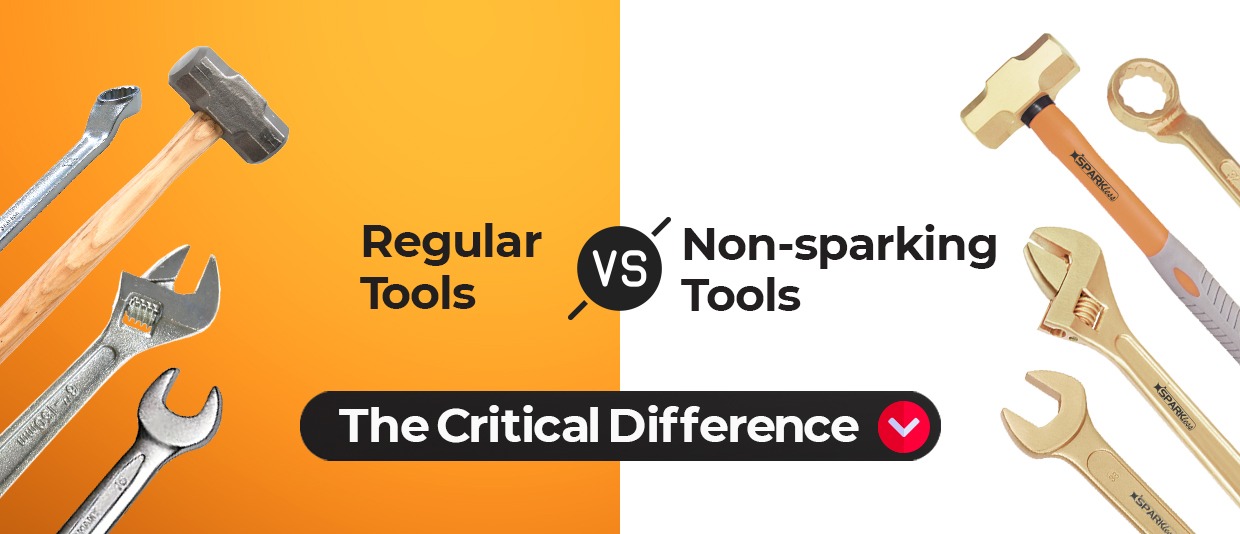
Regular Tools vs Non-Sparking Tools: The Complete What Are Non-Sparking Tools?
In industries where flammable gases, vapours, or combustible dust are present, the choice between a regular steel tool and a non-sparking safety tool is not a matter of preference; it is a matter of life, compliance, and liability. A single spark from a standard wrench in an oil refinery or a pharmaceutical solvent room can trigger a catastrophic explosion. This guide breaks down everything you need to know about non-sparking tools vs regular tools: materials, applications, safety standards, and how to choose the right tool for your hazardous work environment.
Table of Contents
- What are Non-sparking Tools?
- Key Material Differences
- Types of Non-sparking tools?
- Safety Standard & Compliance
- FAQ's
- Conclusion
01. What Are Non-Sparking Tools?
Non-sparking tools (also called spark-resistant tools or spark-proof tools) are hand tools manufactured from alloys that do not produce incendive sparks when they strike or scrape against hard surfaces, ferrous metals, or rough concrete. Unlike standard carbon steel tools, these tools are made from copper-beryllium, aluminum-bronze, or titanium alloys materials that deform on impact rather than fracturing and releasing burning metal particles.
The term "non-sparking" is technically a misnomer: these tools can still produce cold sparks (tiny metal particles) under friction, but these sparks do not have sufficient heat or energy to ignite flammable atmospheres. This is why they are also described as spark-reduced or intrinsically safe hand tools in many safety standards.
Critical Safety Note
Non-sparking tools must always be used in combination with proper ventilation, gas detection systems, and personal protective equipment (PPE). No hand tool alone provides absolute explosion prevention.
How Sparks Form in Regular (Steel) Tools
These sparks can reach temperatures exceeding 1,500°C (2,372°F), which is well above the ignition temperature of common industrial solvents, gases, and dusts. In a confined space with even trace amounts of hydrogen, acetylene, or petroleum vapors, one spark is enough.
02. Key Material Differences
Regular | Non-sparking | Non-sparking |
Carbon / Chrome-Vanadium Steel
| Copper-Beryllium (CuBe2)
| Aluminum-Bronze (Al-Br)
|
Extremely hard and durable. Produces hot ferrous sparks on impact. Used in all standard hand tools globally. | The gold standard for non-sparking tools. Excellent hardness, wear resistance, and corrosion resistance. Preferred for oil & gas applications. | Widely used alternative to CuBe2. Good mechanical strength, magnetic-free, and beryllium-free — safer to manufacture. |
Non-sparking | Non-sparking |
Titanium
| Stainless Steel (304/316)
|
Lightweight and strong. Ideal for aerospace and defence. Spark-resistant due to its oxide layer properties. | Mildly spark-reduced. Used primarily in pharmaceutical and food-grade applications. Not recommended for highly explosive atmospheres. |
03. Types of Non-Sparking Tools Available
Modern non-sparking hand tools cover virtually every category of standard tool. Safety-critical industries no longer have to compromise on tool variety:
Striking & Impacting Tools
Non-sparking hammers , including ball-peen, sledge, and dead-blow variants, are among the most critical tools in explosive environments. Standard steel hammers produce the most dangerous sparks because of the large surface area and high impact energy involved.
Spanners & Wrenches
Non-sparking spanners (open-end, ring, combination, adjustable) allow maintenance personnel to tighten or loosen fasteners safely near flammable pipelines. These are mandatory across oil refineries and LNG terminals.
Allen Keys (Hex Keys)
Non-sparking Allen keys made from copper-beryllium are essential for working on valve actuators, pump covers, and instrumentation panels in hazardous zones.
Pliers & Gripping Tools
Non-sparking pliers including slip-joint, needle-nose, and locking types eliminate friction sparks during gripping, pulling, or bending operations on cables and fittings.
Screwdrivers
Non-sparking screwdrivers with Cu-Be or Al-Br tips are used for instrument panel maintenance in ATEX Zone 1 and Zone 2 environments.
Cutting Tools, Chisels & Punches
These generate the most friction per strike and require spark-resistant materials. Non-sparking chisels and punches are used in demolition and maintenance tasks within flammable storage areas.
Sockets & Socket Accessories
Non-sparking sockets (metric and imperial) paired with ratchet handles allow fast, safe disassembly of equipment in confined classified spaces.
Specialized Tools
This category includes non-sparking drum openers (bung wrenches), flange wedges, cylinder keys, scrapers, files, brushes, and complete OISD emergency tool kits as mandated by Indian oil industry safety directives.
04. Safety Standards & Compliance
IS 3694 (India – BIS Standard)
Bureau of Indian Standards specification IS 3694 defines requirements for non-sparking tools, including material composition, mechanical properties, and testing procedures. Bombay Tools Centre supplies tools compliant with IS 3694 from leading manufacturers.
OISD-117 & OISD-105
These Oil Industry Safety Directorate standards govern fire prevention and safety requirements in petroleum refineries and marketing installations across India. Both explicitly mandate the use of non-sparking tools in classified hazardous zones.
05. Frequently Asked Questions
Are non-sparking tools mandatory in all industrial facilities in India?
No, not in all facilities. They are mandated specifically in classified hazardous areas as defined by OISD-117, OISD-105, and relevant state petroleum rules. This includes petroleum refineries, chemical plants, solvent storage areas, explosives manufacturing units, and similar environments. Standard workshops and general construction sites do not require them.
What is the difference between non-sparking tools and VDE insulated tools?
Non-sparking tools protect against fire and explosion by minimizing incendive sparks in flammable atmospheres. VDE insulated tools protect against electric shock and are rated for use on live circuits up to 1000V AC / 1500V DC. These are distinct categories one does not replace the other. Some specialized tools combine both properties.
Can non-sparking tools be used with power tools or impact wrenches?
Generally, non-sparking hand tools are designed for manual use. Some non-sparking sockets and accessories are rated for pneumatic use with specific torque limits. Always consult the manufacturer's specifications before pairing non-sparking accessories with power equipment.
How do I maintain and care for non-sparking tools?
Keep non-sparking tools clean and dry. Store them separately from ferrous (iron/steel) tools to prevent iron particle contamination, which can nullify their non-sparking properties. Clean with a non-abrasive cloth. Do not use grinding wheels designed for steel. Periodically inspect for cracks, pitting, or severe wear, and replace damaged tools immediately.
Which is better copper-beryllium or aluminum-bronze non-sparking tools?
Copper-beryllium (CuBe2) offers superior hardness (up to 45 HRC), better wear resistance, and superior non-sparking performance. It is preferred for the most demanding ATEX Zone 1 applications. Aluminum-bronze is a strong, cost-effective alternative, is beryllium-free (making it safer to machine), and performs excellently in Zone 2 areas and most general hazardous environments. Both meet IS 3694 and ATEX standards.
Are non-sparking tools magnetic?
No. Copper-beryllium and aluminum-bronze tools are non-magnetic, which makes them doubly valuable in environments where magnetism could interfere with instrumentation or attract metal shavings to sensitive equipment such as in MRI facilities, submarine work, or precision electronics manufacturing.
Where can I buy certified non-sparking tools in India?
Bombay Tools Centre (thebombaytools.com) is one of India's leading specialized distributors of certified non-sparking hand tools, VDE insulated tools, and OISD emergency tool kits, serving major oil & gas, chemical, pharmaceutical, and mining industries across the country. All products come with material certification and full traceability documentation.
Explore Our FAQ's Blog
Conclusion
The distinction between regular tools and non-sparking tools is not a technical nuance it is the difference between a controlled work environment and a potential disaster. For any facility handling flammable gases, volatile solvents, combustible dust, or explosive materials, spark-resistant safety tools are a non-negotiable investment in human life, regulatory compliance, and operational continuity.
Whether you need copper-beryllium spanners for an oil refinery, aluminum-bronze hammers for a chemical plant, or a complete OISD emergency tool kit for your petroleum storage facility, ensure you source from a supplier who provides certified materials, documented traceability, and deep industry knowledge.